
Roof Systems
Spray Polyurethane Foam Roofing in Midland, TX
Spray Foam Roofing: The System That Solves the Roof Membranes Can't
Spray polyurethane foam isn't a membrane at all — it's a fully insulating, joint-free roof assembly that's sprayed on liquid and expands into a rigid closed-cell foam. On the right building, mostly metal structures and roofs with irregular geometry, it solves problems that TPO, EPDM, or modified bitumen can't touch as cleanly.
How the Assembly Actually Works
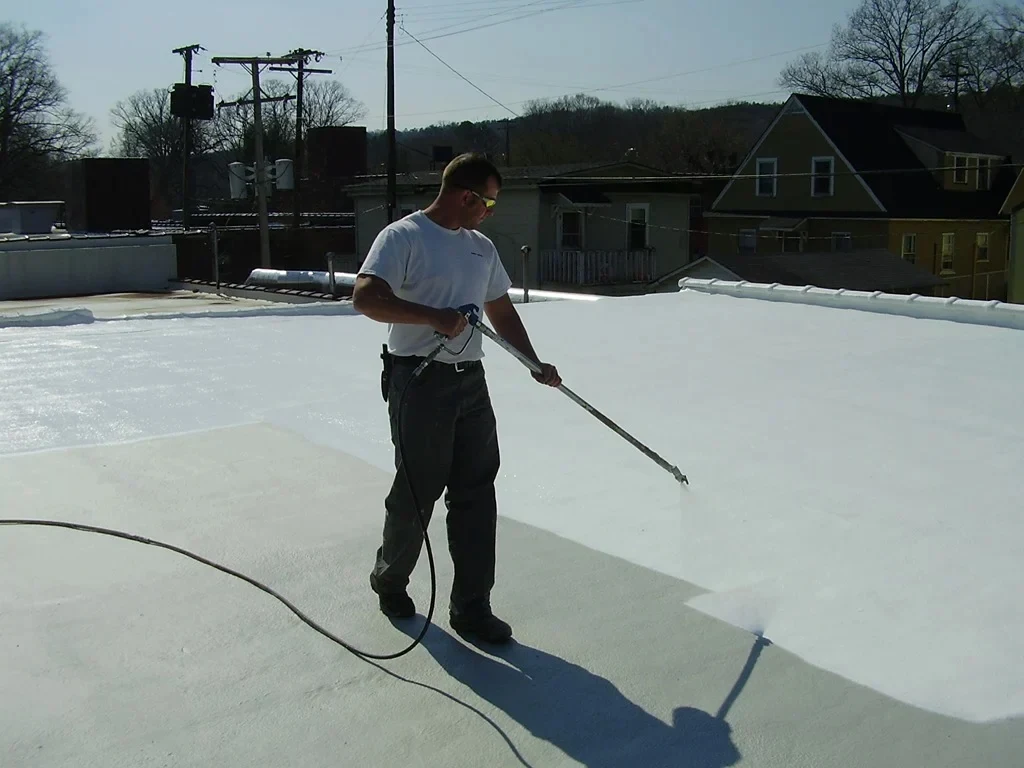
SPF is applied as a two-component liquid — an isocyanate and a polyol resin — that reacts on contact and expands roughly thirty times its liquid volume into rigid closed-cell foam within seconds. Because it's sprayed rather than laid in sheets, it follows the existing roof's contours, curbs, and penetrations without seams, without cut-and-fit flashing at every irregular transition, and without the field joints that are usually where a sheet membrane eventually fails.
Once cured, the foam is protected with a topcoat — usually silicone or acrylic — because SPF itself isn't UV stable and will degrade under direct sun exposure if left uncoated. The topcoat is not optional; it's the wear surface that protects the insulating foam underneath for the life of the system.
Why R-Value Changes the Conversation
Every other system in this lineup is a waterproofing membrane installed over separate insulation board. SPF is both the insulation and the water barrier in one monolithic layer, with an R-value per inch that's higher than most rigid foam board insulation used under single-ply membranes. On a metal building with minimal existing insulation — a lot of the oilfield service structures and equipment sheds around Midland fall into this category — spraying foam directly to the underside of the existing roof panels adds real thermal performance in a single pass, on top of solving the water intrusion problem.
That combined insulation-and-waterproofing role is the main reason SPF costs less over a building's life than it looks like on a bid sheet — it's replacing two systems' worth of work with one application.
Joint-Free Performance on Irregular Rooflines
Metal buildings with standing-seam panels, ridge caps, multiple roof pitches, and dozens of small penetrations for vents, conduit, and equipment mounts are difficult roofs to waterproof with a sheet membrane, because every seam and transition is a potential leak point. Spray foam eliminates that problem by conforming directly to the existing geometry rather than requiring the roof to be flat and regular for a membrane to lie correctly. This is the single biggest reason SPF shows up so often on metal warehouse and service-yard buildings rather than on straightforward flat commercial roofs, where a membrane system is usually simpler and more economical.
Wind and Hail Performance
A properly applied SPF roof bonds directly and continuously to the substrate, which gives it strong wind-uplift resistance without relying on discrete mechanical fasteners at all — the adhesion is the attachment system. That matters on Midland's open, Exposure C terrain where the straight-line winds ahead of a dryline storm put real load on any rooftop.
Hail is the one area where SPF needs a straight answer: the foam itself can be damaged by a hard enough impact, and the protective topcoat is the first line of defense. We spec topcoat thickness and sometimes a granulated or aggregate-embedded surface specifically for hail-prone applications, since topcoat performance under impact is what determines how the system holds up through a bad spring storm season.
Building types where SPF fits Midland's roof stock
- Metal warehouse and equipment-shed buildings at oilfield service yards
- Buildings with complex rooflines, multiple pitches, or heavy penetration counts
- Older metal buildings needing added insulation along with water intrusion repair
- Recover applications over failing built-up or modified bitumen roofs with irregular surfaces
- Buildings where minimizing seams and field joints matters more than initial material cost
Topcoat Maintenance and Recoat Cycles
SPF's long-term performance depends on the topcoat, not the foam itself, since the foam is protected as long as the coating stays intact. Recoat intervals depend on topcoat chemistry, UV exposure, and hail history, and we build that maintenance schedule into the conversation at install rather than treating SPF as a set-and-forget system. Skipping a scheduled recoat is the most common way an otherwise well-installed SPF roof underperforms its expected service life.
Common Questions on Spray Foam Roofing
Does spray foam work on a flat commercial roof, or only metal buildings?
It can, but the joint-free, contour-following advantage matters most on irregular rooflines. On a straightforward flat roof, a membrane system is often simpler and more cost-effective.
Is SPF safe under Midland's UV exposure?
The foam itself is not UV stable, which is why a protective topcoat is mandatory, not optional. A properly maintained topcoat protects the foam for the system's full service life.
How does SPF handle hail impact?
Performance depends on topcoat thickness and any aggregate surfacing specified for impact resistance. We tailor topcoat spec to hail exposure on a given building.
Can SPF be applied over an existing metal roof without tearing it off?
In most cases yes, which is one of SPF's real advantages — it can go directly over sound existing metal roofing, adding insulation and sealing seams and fasteners in one application.
How often does an SPF roof need a new topcoat?
It varies by coating chemistry, UV exposure, and weather history, which is why we set a recoat schedule at install rather than waiting for visible degradation to prompt the next service call.