
Roof Systems
SBS Modified Bitumen Roofing in Midland, TX
SBS Modified Bitumen: Built-Up Roofing's Rubberized Successor
A lot of Midland's older commercial building stock — downtown offices, some of the original oilfield-era warehouses — still carries built-up roofing or a first-generation modified bitumen system nearing the end of its life. SBS modified bitumen is usually what we recommend replacing it with, and it's worth understanding why the membrane still holds up against newer single-ply options.
What SBS Actually Does to Asphalt
Styrene-butadiene-styrene is a synthetic rubber compound blended into asphalt to give the resulting membrane real elasticity, where straight asphalt is stiff and brittle, especially in cold weather. An SBS-modified sheet stretches and recovers rather than cracking, which matters through the wide temperature range Midland sees between summer roof-surface heat and the sharp drops a blue norther brings overnight in fall and winter. That elasticity is the entire reason SBS modified bitumen replaced straight built-up asphalt roofing as the standard heavier-membrane option.
The membrane is manufactured with a reinforcement mat — typically fiberglass or polyester — embedded in the modified asphalt, giving the sheet tensile strength on top of the rubber compound's flexibility.
Multi-Ply Redundancy
Where single-ply membranes like TPO or PVC rely on one sheet doing all the waterproofing work, SBS modified bitumen is almost always installed in two plies — a base sheet and a cap sheet — which gives the finished roof a built-in redundancy that single-ply doesn't have. A puncture or seam issue in the cap sheet doesn't necessarily mean water reaches the deck if the base sheet underneath is intact and properly lapped.
That redundancy is one reason modified bitumen holds up well on roofs with heavier foot traffic or equipment loads, and it's part of why we still spec it on some industrial and manufacturing buildings where rooftop activity is more constant than on a typical office roof.
Torch-Applied Versus Cold-Adhesive Install
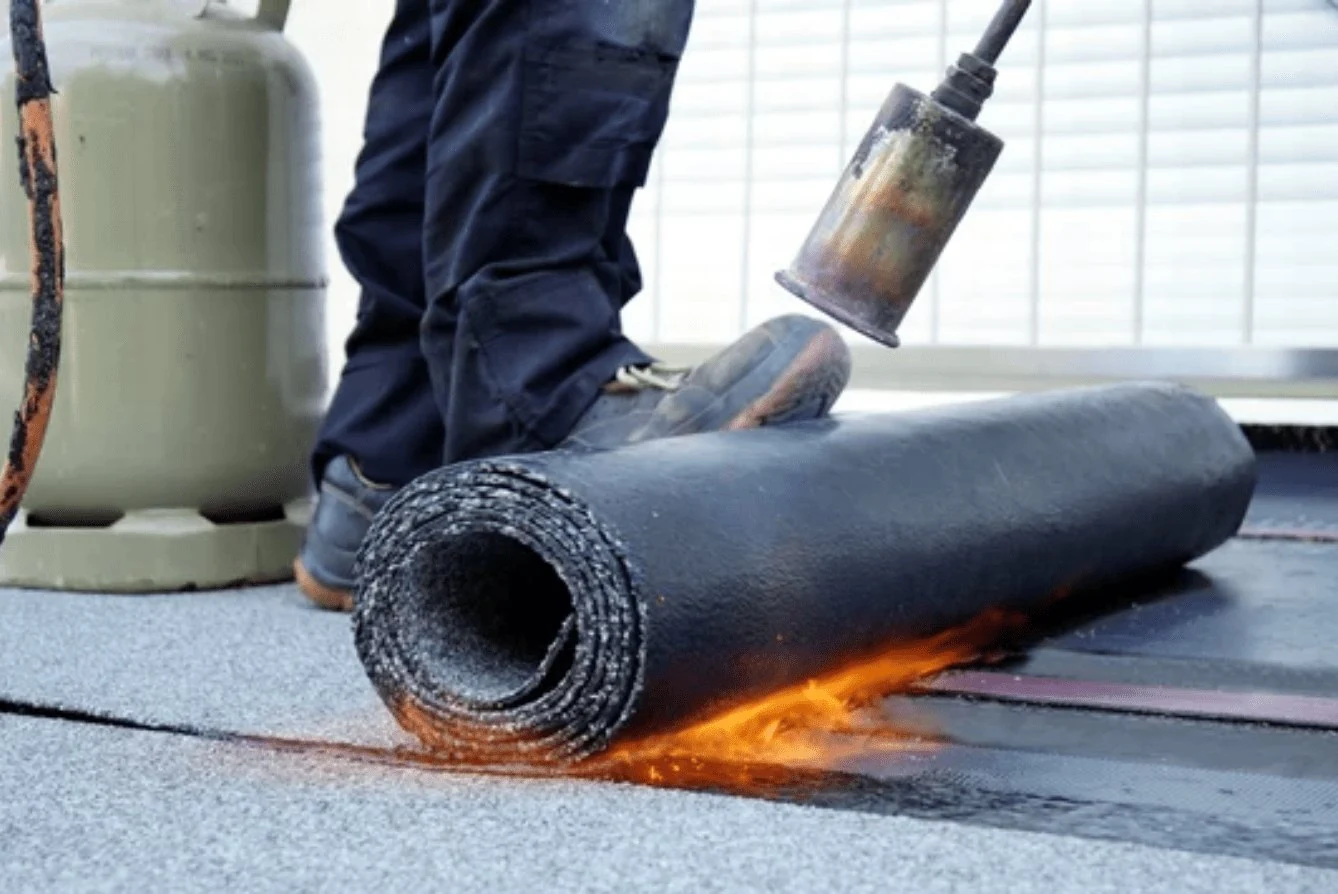
SBS cap sheets get installed one of two main ways: torch-applied, where a propane torch melts the asphalt backing to bond the sheet to the substrate below, or cold-adhesive, where a cold-process asphalt adhesive bonds the sheet without open flame. Torch application gives a strong, fully fused bond but requires real fire-safety discipline on the roof — hot work permits, fire watch, and careful sequencing around insulation and any combustible substrate.
Cold-adhesive systems eliminate the open-flame risk entirely, which matters on occupied buildings, roofs near flammable storage, or job sites where a fire watch isn't practical. We choose between the two based on the building's occupancy and the substrate conditions, not on crew preference alone.
Granule Surfacing and UV Protection
Most SBS cap sheets come factory-surfaced with mineral granules, which protect the modified asphalt underneath from direct UV degradation — a real consideration given how much sun exposure a Midland rooftop takes across a year. Granule-surfaced membranes typically get a walk-off inspection after any hail event, since granule loss from a hard hailstrike is one of the more visible early signs of impact damage, even before it becomes a functional leak.
Smooth-surfaced modified bitumen exists too, usually paired with a separate reflective coating, which we'll spec on buildings where surface reflectivity matters more than granule protection alone.
Where SBS modified bitumen fits Midland's building stock
- Older downtown office and commercial buildings replacing legacy built-up roofing
- Industrial and manufacturing roofs with heavy foot traffic or equipment loads
- Steeper-slope sections and roof-to-wall transitions where single-ply detailing gets difficult
- Buildings needing multi-ply redundancy over sensitive interior space
- Recover projects over an existing modified bitumen or built-up roof in fair condition
Wind and Hail Performance
Properly adhered SBS modified bitumen performs well under wind uplift because the fully bonded plies resist uplift across the whole surface rather than depending on discrete fastener points, which suits Midland's open, Exposure C terrain and the straight-line wind events that come through with dryline storms. Hail resistance benefits from the membrane's inherent thickness and multi-ply construction — there's simply more material between a hailstone and the deck than with a single-ply sheet, though granule loss from impact is still something we check for after any significant storm.
Base-sheet attachment — whether mechanically fastened or adhered — gets engineered to the specific roof's height and exposure the same as any other membrane system we install.
Common Questions on SBS Modified Bitumen
Is modified bitumen the same as old built-up asphalt roofing?
No. Straight built-up roofing is layers of asphalt-saturated felt without the rubber-modified elasticity SBS brings, and it's stiffer and more prone to cracking in cold weather than SBS modified bitumen.
Is torch-applied roofing safe on an occupied building?
It can be, with proper fire-watch procedures and hot-work permits, but cold-adhesive application removes the open-flame risk entirely and is often the better choice for occupied structures.
How long does SBS modified bitumen typically last?
Service life depends heavily on installation quality, ply count, and surfacing, with granule-surfaced multi-ply systems generally providing strong long-term performance when properly maintained and inspected after storm events.
Can modified bitumen be coated later to extend its life?
Yes, a reflective coating can be applied over a sound modified bitumen roof nearing the end of its granule-protected life, which is a common way to extend service life without a full tear-off.
Does modified bitumen handle Midland's UV exposure well?
Granule surfacing protects the modified asphalt from direct UV degradation effectively, though granule loss from hail or foot traffic reduces that protection over time and is worth tracking during inspections.