Roof Systems
White EPDM Roofing in Midland, TX
White-Faced EPDM: Rubber Flexibility Without the Black Heat Load
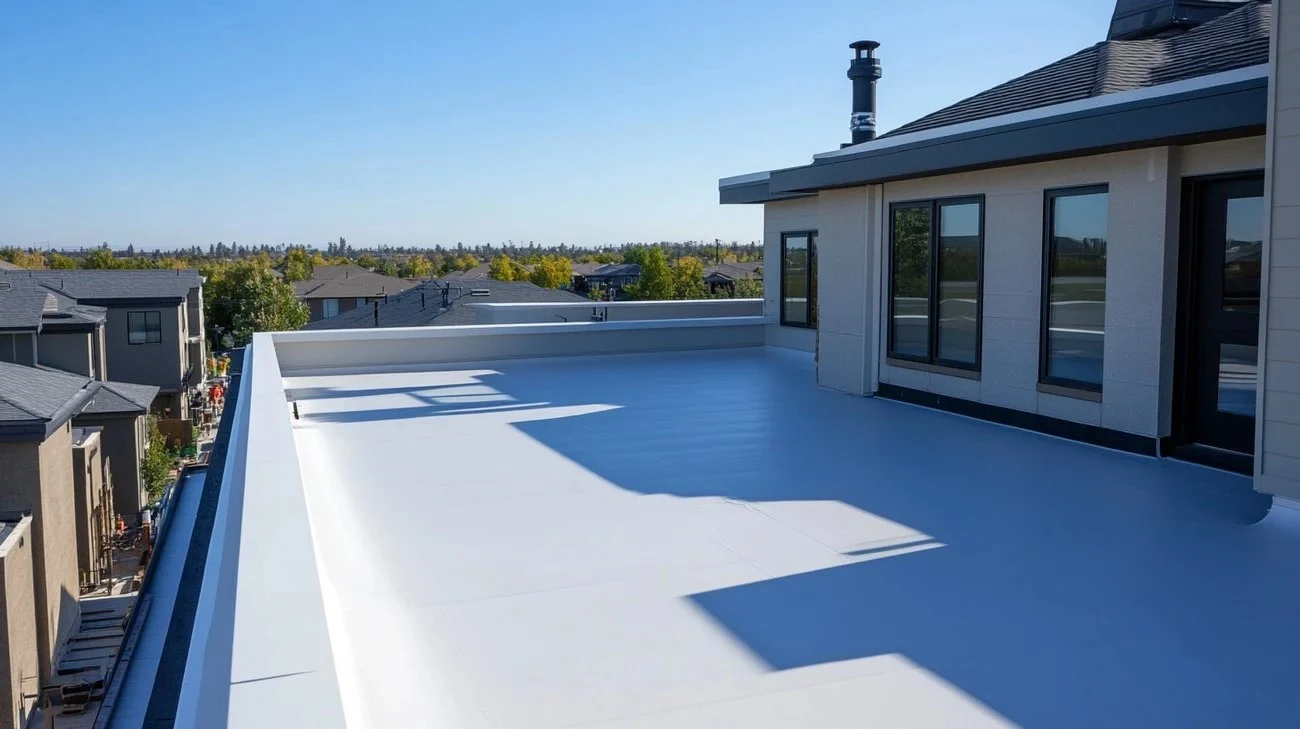
Some owners want EPDM's flexibility and adhesive-seam durability but don't want the surface heat a black membrane brings under Midland's sun. White EPDM — sometimes called white-on-black, since the reflective surface is typically laminated to a standard black rubber sheet — splits that difference, and it comes up more often than people expect once we explain what it actually is.
Construction: Two Compounds, One Sheet
Most white EPDM is not rubber pigmented white all the way through. It's a thin white thermoplastic or reflective laminate bonded to the top face of a standard black EPDM sheet, giving the roof a reflective surface while keeping the rubber's core flexibility and adhesive-seaming approach underneath. That construction matters for maintenance — the white face can show wear or soiling differently than a homogeneous membrane would, and we account for that when we walk a white EPDM roof during inspection.
Underneath that surface layer, the membrane behaves like standard black EPDM in terms of flexibility across temperature swings, tear resistance, and adhesive seam chemistry. It doesn't heat-weld any more than black EPDM does.
Reflectivity and Building Load
The whole reason to spec this membrane over standard black is surface temperature. A reflective face keeps the membrane and the deck below it running cooler under direct sun than a black sheet would, which matters on a conditioned building where every degree of rooftop heat gain becomes cooling load somewhere in the mechanical system. Midland's UV exposure is high enough, and the cooling season long enough, that this isn't a marginal consideration for an owner running HVAC across a big single-story floor plate.
For unconditioned buildings — service yard structures, storage sheds without real climate control — the reflectivity advantage matters less, and standard black EPDM is usually the more economical choice for that application instead.
Seaming and Long-Term Seam Maintenance
Adhesive seams are the tradeoff for choosing rubber over a welded thermoplastic. A properly primed, properly cured seam performs well for years, but the workmanship window is narrower than with hot-air welding — surface prep, adhesive open time, and roller pressure all affect how the seam holds up. We inspect seam edges specifically during any service call on a white EPDM roof, since that's typically where an aging system starts to show its age before the field membrane does.
Given Midland's swing between summer heat and the sharp cold snaps a blue norther can bring through, seam adhesive needs to be applied within the manufacturer's temperature window, rather than whenever the crew happens to be on the roof.
Attachment Options for This Membrane
White EPDM can run mechanically fastened or fully adhered, the same choice as black EPDM. On buildings with real wind exposure — and open, flat Exposure C terrain describes most of Midland County — we favor mechanical fastening with tightened perimeter and corner patterns for straightforward buildings, and fully adhered systems for buildings where uplift performance needs to be as even as possible across the whole field, like taller structures or buildings closer to open highway frontage with nothing upwind to slow a gust.
Ballasted white EPDM exists but is less common, since the reflective face is part of what an owner is paying for, and burying that surface under stone ballast works against the reason to choose the membrane in the first place.
Building types where white EPDM fits well in Midland
- Conditioned office and professional buildings wanting reflectivity without a full switch to TPO
- Medical office and clinic buildings with steady HVAC demand
- Retail and multi-tenant strip buildings with real cooling loads
- Recover projects over an aging black EPDM roof where reflectivity is now a priority
- Buildings needing rubber's flexibility through wide seasonal temperature swings
Hail and Wind Considerations
Impact resistance follows the same logic as black EPDM — the rubber compound flexes under hail impact rather than fracturing outright, and a properly specified cover board underneath does more to protect against hail damage than the surface laminate does on its own. Wind performance depends on attachment method and fastening density at the perimeter and corners, which we engineer to the specific building's exposure rather than applying one standard pattern across every roof.
The straight-line wind events that move through with dryline storms in this part of Texas put real load on perimeter and corner attachment zones, and that engineering matters more to uplift performance than which membrane color sits on top.
What Owners Ask About White EPDM
Is white EPDM the same rubber as black EPDM underneath?
Yes — most white EPDM is a reflective face laminated onto a standard black rubber sheet, so the core flexibility and seam chemistry are the same as black EPDM.
Does the white face stay clean in West Texas dust?
Dust and wind-blown grit are part of any roof's maintenance picture here, white or otherwise. Reflectivity can diminish with surface soiling over time, which periodic cleaning during inspection can help maintain.
Is white EPDM more expensive than black?
Typically somewhat more, given the added reflective laminate, though usually less than a comparable TPO system.
How does white EPDM compare to TPO for reflectivity?
Reflectivity performance is broadly comparable at installation, though the two membranes age differently — worth discussing specifically for a given building's exposure and expected service life.
Can an existing black EPDM roof be recovered with white EPDM?
Often yes, provided the existing substrate is sound and dry, which we verify with moisture testing before recommending a recover over a tear-off.