
Commercial Roofing Services
Built-Up Roofing (BUR) in Midland, TX
Built-Up Roofing on Midland's Older Downtown Buildings
Built-up roofing — the ply-and-gravel system some people still call tar-and-gravel — is still in service on a number of older buildings around downtown Midland, and it remains a system we maintain, patch, and occasionally recoat rather than automatically tear off. Understanding what's actually holding an existing BUR roof together matters more than defaulting to full replacement the moment a leak shows up.
How a Built-Up Assembly Actually Works
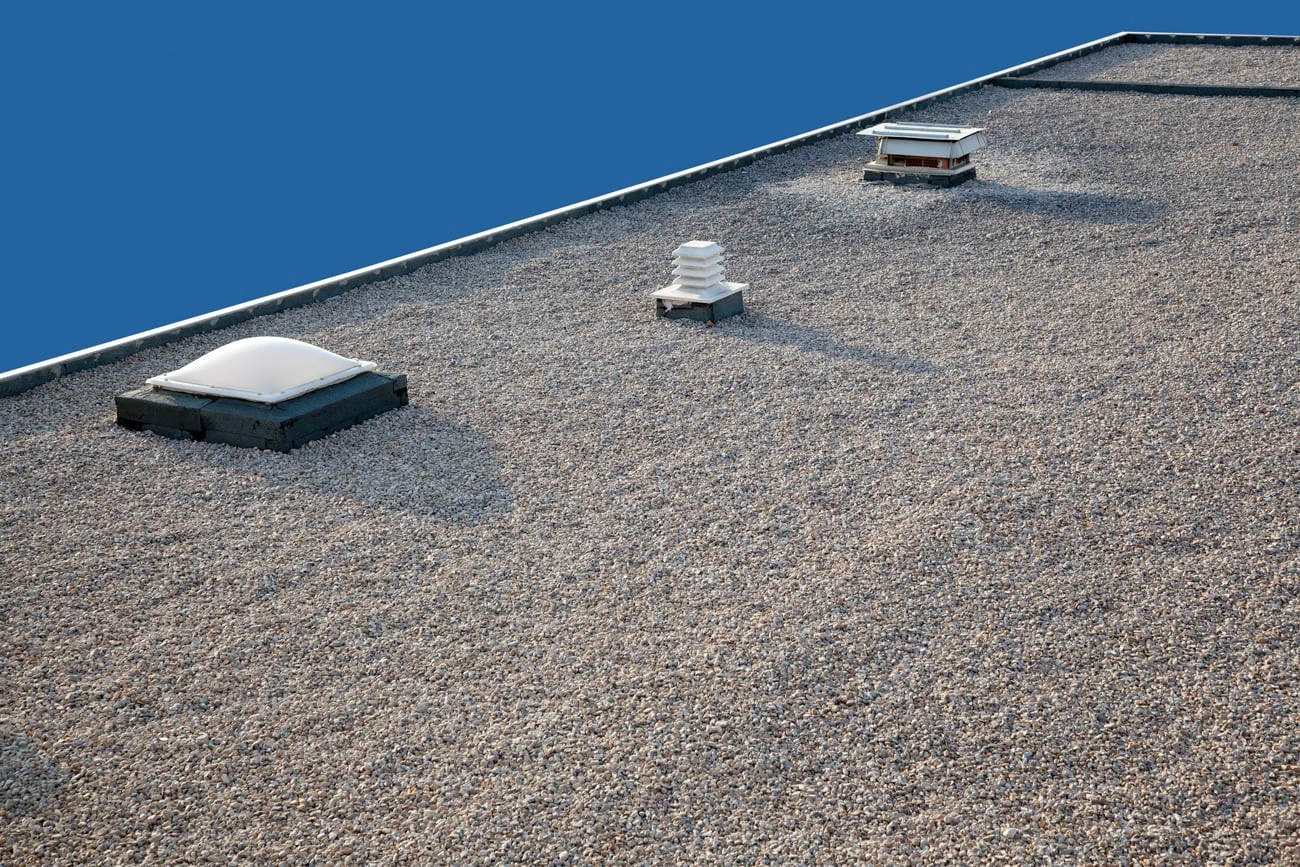
A BUR roof is built from alternating layers — typically three to five plies of roofing felt saturated with asphalt or coal tar pitch, embedded between hot-mopped bitumen, and finished with a gravel or mineral ballast surface. Each felt ply adds redundancy, similar in principle to modified bitumen's layered logic but with more plies and a heavier overall assembly. That mass and redundancy is why some of these roofs have been in service for decades on Midland's older office and civic buildings.
Ply count also affects service life expectations — a four or five-ply system generally outlasts a three-ply system built to a lower original budget, and knowing which configuration is under the gravel on a given building changes how we forecast its remaining useful life.
The gravel ballast on top does double duty — it protects the asphalt plies below from direct UV exposure, and it adds weight that helps resist wind uplift on the field of the roof. That's a real advantage in this wind exposure category, though ballast alone doesn't solve uplift risk at the perimeter and corners, where wind pressures run highest and gravel can scour away entirely in a strong event.
What Actually Fails on These Roofs
Most BUR failures we find aren't a wholesale collapse of the ply system — they're localized. Flashing details at parapets, drains, and roof-mounted equipment curbs age faster than the field plies, since those transition points see more movement and more direct water exposure than the flat field of the roof. Ballast loss from wind scour exposes the asphalt plies below to direct UV, accelerating embrittlement in exactly the spots where gravel has migrated or blown off.
We evaluate an existing BUR roof by walking the whole field and checking ballast depth and distribution, flashing condition at every penetration, and moisture content in the deck below using an infrared or capacitance survey where the roof's history is unclear. That tells us whether a targeted repair, a recoat, or a full replacement is the honest recommendation — not a blanket answer applied before we've actually looked.
We also check for interply moisture between the felt layers, not only at the deck level, since a BUR system can trap water between individual plies even when the deck itself tests dry. That kind of trapped moisture shows up as bubbling or soft spots underfoot during a roof walk, well before it becomes visible from below.
When We Recommend Keeping a BUR System
Full tear-off isn't always the right call on an older downtown building, particularly when:
- The deck below tests dry and structurally sound despite the roof's age
- Ballast coverage is largely intact with only localized bare or thin spots
- Flashing details can be repaired or reinforced without disturbing the field plies
- The building's ownership or use is expected to change in the near term, favoring a lower-cost interim fix
- A reflective coating can address UV exposure on exposed asphalt without a full recover
Where deck moisture shows up in a survey, or where ballast loss and ply exposure are widespread rather than localized, we're direct about recommending replacement instead of patching a roof that's past the point where repair makes financial sense.
Coating and Recover Options for Aging BUR
A silicone or acrylic coating applied over a BUR roof — after cleaning, repairing flashings, and often re-ballasting or embedding aggregate into the coating — restores UV protection and buys years of additional service life on a roof that's structurally sound but showing surface wear. This is often the most cost-effective move on a downtown building where full replacement isn't in the current budget cycle.
On buildings where the deck and ply system are too far gone, we look at a full recover with a new modified bitumen cap system tied into the existing plies, or a complete tear-off to a new single-ply membrane, depending on what the structure and budget can support.
Frequently Asked About Older Built-Up Roofs
Is a built-up roof outdated technology that should just be replaced?
Not automatically. Plenty of BUR roofs on Midland's older downtown buildings are structurally sound and just need targeted flashing repair and ballast restoration rather than full replacement.
How do you tell if a BUR roof still has useful life left?
We check deck moisture content, ballast coverage, and flashing condition across the whole field. A dry deck with mostly intact ballast usually means the roof has years left with the right maintenance.
Does gravel ballast actually help against West Texas wind?
It adds resistance in the field of the roof, but perimeter and corner zones see higher uplift pressures where ballast alone isn't sufficient — those areas need proper flashing and edge detailing regardless of ballast weight.
Can you coat an old BUR roof instead of replacing it?
Often, yes, if the deck is dry and the plies are intact. See our silicone coatings page for how that process works on an aging asphalt-based roof.
What's the biggest risk with an aging BUR roof in this market?
Ballast loss from wind exposing the asphalt plies to direct UV, which accelerates deterioration faster than most owners expect once it starts.