
Commercial Roofing Services
Modified Bitumen Roofing in Midland, TX
Modified Bitumen Systems for Strip Retail and Multi-Layer Roof Redundancy
Modified bitumen still earns a place on our spec sheet for multi-tenant retail strips and hotel roofs around Midland where a layered, redundant assembly makes more sense than a single-ply sheet. It's an older technology than TPO or PVC, but the multi-ply approach handles certain conditions — patched substrates, complex flashing details, budget-driven phased projects — better than a thermoplastic membrane would.
What Modified Bitumen Actually Is
Modified bitumen combines asphalt with a rubber or plastic modifier — typically SBS (styrene-butadiene-styrene) for flexibility or APP (atactic polypropylene) for heat resistance — reinforced with a polyester or fiberglass mat. The SBS variant is what we spec most often in this market because its rubberized flexibility handles Midland's daily temperature swings and thermal cycling better than the stiffer APP formulation, which can become brittle faster under repeated hot-cold cycling.
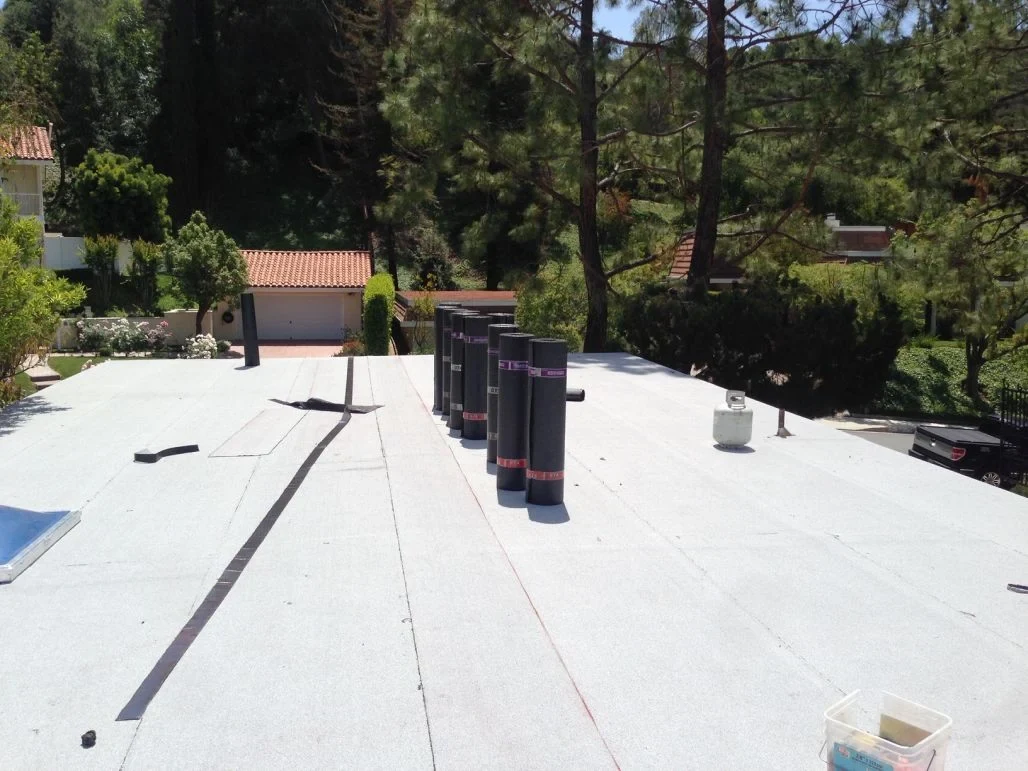
The system builds in layers rather than relying on a single membrane sheet — typically a base sheet, sometimes an interply sheet, and a cap sheet on top. That redundancy is the whole point: if one layer develops a pinhole or seam issue, the layer beneath it is still doing waterproofing work, which is a real advantage on buildings where a leak going undetected for months would cause serious damage.
Cap sheet granule color also affects performance here — a lighter-colored cap sheet reflects more solar load than a traditional dark granule surface, and on buildings without a planned coating cycle, that granule color choice is one of the few reflectivity decisions built into the system from day one.
Application Method and Why It Matters for Retail Strips
We install modified bitumen using torch-applied, hot-mopped, self-adhered, or cold-adhesive methods depending on the building's occupancy and fire code constraints. On active multi-tenant retail strips where tenants are open for business during roof work, self-adhered or cold-adhesive application avoids the open flame and hot asphalt fumes that torch-applied or hot-mopped methods bring, which matters for occupied storefronts below.
Seam lap width and consistent heat or adhesive application at every seam determine long-term watertightness more than almost any other installation variable. We track seam quality the same way we do on single-ply membranes — checking every lap, not sampling a percentage and assuming the rest are fine.
We also evaluate the condition of the base sheet on any recover project before adding a new cap sheet layer. A base sheet that's already blistered or delaminated from the deck won't provide reliable support for a new cap layer, and in that case, addressing the base sheet first is worth the extra time rather than building a new layer over a compromised foundation.
Where This System Fits in Our Spec Decisions
Modified bitumen tends to win out over single-ply membranes in a few specific situations:
- Recover projects over an existing built-up or modified bitumen roof where matching the substrate simplifies tie-in
- Buildings with heavy foot traffic or mechanical equipment where a multi-layer assembly resists puncture better
- Complex flashing details around numerous rooftop units common on older retail strip centers
- Phased re-roofing budgets where a cap sheet can be added over an existing base in stages
- Buildings where redundancy matters more than reflectivity, such as unconditioned storage areas behind retail
On a downtown office tower with a full HVAC plant and reflectivity-driven cooling savings in mind, we usually steer toward TPO instead. Modified bitumen earns its place on the buildings where layered redundancy and flashing flexibility matter more than surface reflectivity.
Coating Options to Extend the System
A cap sheet's granulated surface provides some UV protection on its own, but a reflective coating — acrylic or silicone depending on ponding conditions — extends service life further and cuts surface temperature under Midland's intense summer sun. We often recommend a coating cycle partway through a modified bitumen roof's expected service life rather than waiting until visible deterioration shows up, since catching UV degradation early is cheaper than a full recover later.
Fastening and attachment at the perimeter still has to account for this region's wind exposure, even though modified bitumen is typically adhered rather than mechanically fastened across the field — perimeter and corner detailing get extra attention regardless of the overall attachment method.
Common Questions on Modified Bitumen
Is modified bitumen outdated compared to TPO or PVC?
It's an older chemistry, but not obsolete — the layered redundancy and flashing flexibility still solve problems single-ply membranes don't handle as well, particularly on complex retail strip roofs with lots of rooftop equipment.
Can you install modified bitumen without torching, given it's near occupied retail space?
Yes — self-adhered and cold-adhesive application methods avoid open flame entirely, which we use regularly on active storefronts where tenants are operating during the work.
Does modified bitumen handle West Texas hail well?
The multi-ply, reinforced construction gives it decent impact resistance, generally better than a thin single-ply sheet, though a granulated cap sheet can still show hail scarring that a coating will need to address afterward.
How does SBS compare to APP modified bitumen here?
We favor SBS in this market because its rubberized flexibility handles daily thermal cycling better than APP's stiffer, heat-fused formulation, which can brittle out faster under repeated hot-cold swings.
Can this system be recovered instead of torn off when it ages?
Often, yes, provided the existing layers are dry and adhered properly. See our recover and overlay page for how we evaluate whether a building qualifies.