Commercial Roofing Services
TPO Single-Ply Roofing in Midland, TX
TPO Roofing for Midland's Office Towers and Distribution Buildings
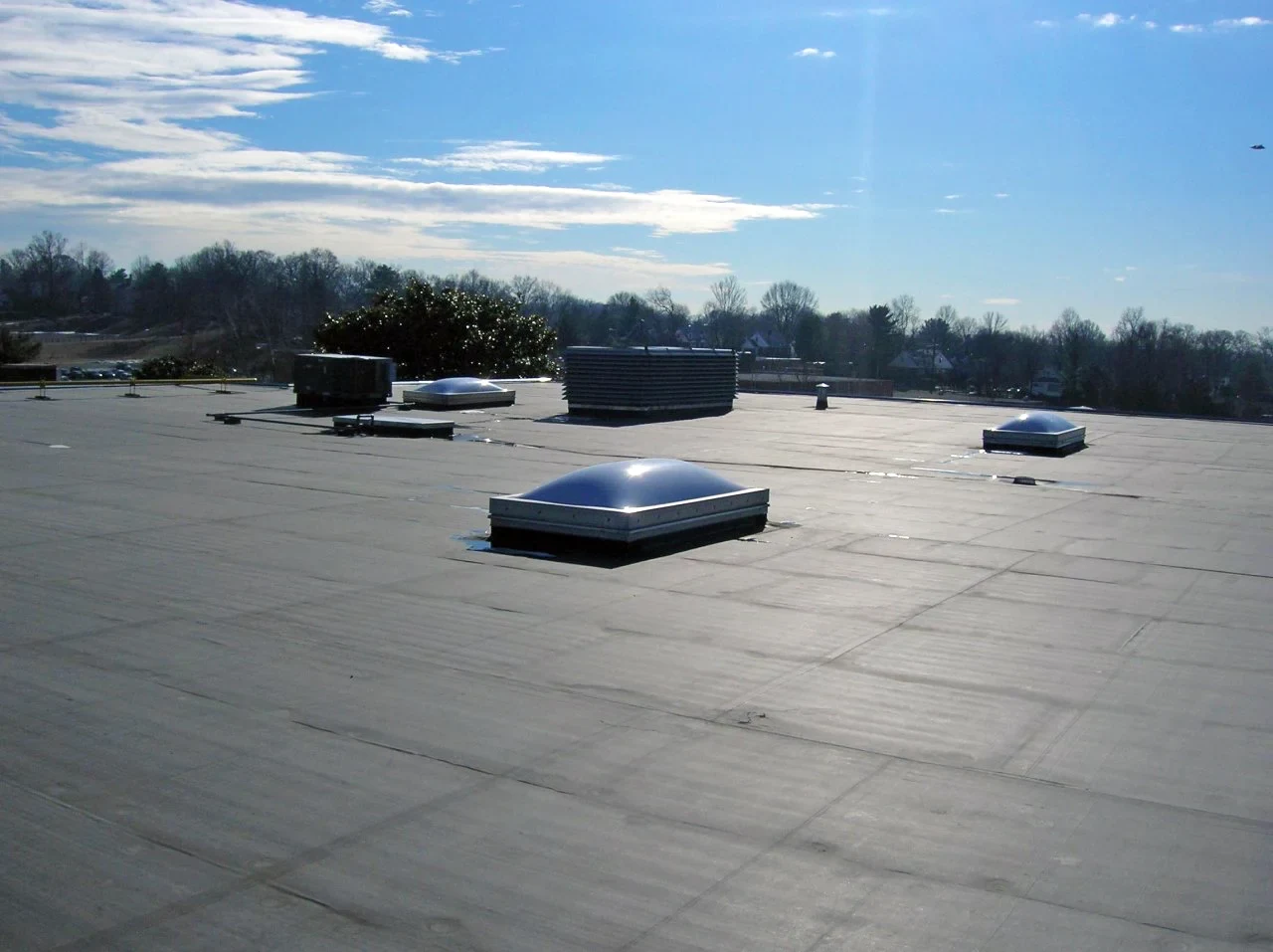
TPO is the single-ply membrane we spec most often on large open low-slope decks around Midland, from downtown office towers to distribution and flex-space buildings off Loop 250. Its heat-welded seams and reflective surface make sense against West Texas heat and UV load, but the membrane still has to be matched to thickness, fastening pattern, and exposure category on a building-by-building basis.
Why the Membrane Chemistry Fits This Climate
TPO's polyester-reinforced scrim gives it tear and puncture resistance that holds up under foot traffic from mechanical service crews, which matters on office towers with rooftop condenser units and constant technician access. The white or light-gray surface reflects a meaningful share of solar load, which keeps membrane surface temperatures lower through Midland's long stretch of clear, high-UV days at altitude — that reflectivity also takes pressure off the building's cooling system, a real consideration for a downtown tower with a full HVAC plant on the roof.
Where TPO can struggle is with prolonged exposure to petroleum-based oils and greases, so on buildings closer to service yards or with kitchen exhaust venting nearby, we'll walk through whether a PVC membrane makes more sense for that specific exposure before defaulting to TPO out of habit.
Manufacturer wind warranties on TPO systems typically require documented fastening patterns and installer certification, and the warranty terms often specify a maximum uplift pressure the system is rated for at a given exposure category. We build the fastening spec to meet or exceed that documented pressure rather than treating the warranty paperwork as an afterthought, since a claim denied for an undocumented deviation defeats the purpose of installing a warrantied system in the first place.
Seam Welding and Why It Matters Here
TPO seams are heat-welded with hot air, typically in the 700-degree range at the welder nozzle, fusing the top and bottom sheets into a single homogenous seam rather than relying on an adhesive bond. That weld strength is what carries wind uplift loads across the field of the roof, so seam quality control — probe testing every welded seam, not spot-checking — is non-negotiable on a job this size, especially with the uplift pressures this region generates at corners and parapets.
We also account for thermal movement in how we detail penetrations and curbs. A TPO membrane expands and contracts through Midland's daily temperature swings more than people expect, and a poorly detailed pipe boot or curb flashing will work loose over a few years of that cycling well before the field membrane shows any wear.
Choosing Thickness and Attachment Method
We spec both 60-mil and 80-mil TPO depending on the building's exposure and expected service life. Thicker membrane resists hail impact and mechanical damage better, which we weigh more heavily on buildings with low parapets or minimal wind screening. Attachment method matters just as much as thickness:
- Mechanically attached — fastened through insulation into deck, cost-effective on large open fields
- Fully adhered — bonded to insulation with adhesive, better for irregular rooflines and lower profile
- Induction-welded — fasteners bonded from below via induction plates, reduces visible fastener patterns
- Ballasted — stone or paver ballast holds membrane down, rarely used here given wind exposure
On most Midland office and distribution buildings, mechanically attached or induction-welded systems make the most sense given the wind uplift pressures common to this exposure category. Ballasted systems carry real risk here — loose stone ballast becomes wind-borne debris in a straight-line wind event, which is part of why we rarely recommend it on open sites.
Insulation and R-Value Under the Membrane
Polyiso insulation typically delivers somewhere around 5.6 to 6.0 R per inch, and we layer board thickness to hit the R-value target for the building's use — an occupied office tower needs a higher target than an unconditioned mechanical penthouse. Board layout also affects thermal bridging: staggered joints in a two-layer system perform better than a single thick layer with continuous seams stacked over the deck's structural members.
We also check the existing insulation for trapped moisture before any recover project. Wet insulation under a new TPO membrane won't dry out on its own, and it will keep degrading R-value and adhesion strength long after the new membrane is welded down.
A cover board layer between insulation and membrane adds another line of defense against hail impact and foot traffic damage, particularly valuable on buildings where rooftop mechanical service crews are up on the roof regularly. High-density polyisocyanurate or gypsum-based cover boards spread point loads more evenly across the insulation below, reducing the chance that a dropped tool or a hailstone punches straight through to the deck.
Common Questions About TPO in This Market
Does TPO handle Midland's heat and UV better than other membranes?
Its reflective surface and UV-stable formulation hold up well against this region's intense solar load and elevation, generally outperforming unprotected black membranes on surface temperature and long-term embrittlement. See our EPDM page for how that compares against white EPDM specifically.
Will TPO hold up against hail?
Thicker 80-mil membrane resists impact better than 60-mil, and we'll spec the heavier gauge on buildings with more open wind and hail exposure. No single-ply membrane is immune to a severe hail event, but proper thickness and a sound deck reduce the damage.
How long does a TPO roof last out here?
Service life depends heavily on UV exposure, seam quality, and how well penetrations were detailed at installation — a well-installed membrane with quality seam welds outlasts a rushed one by years, regardless of brand.
Can TPO go over an existing roof instead of a full tear-off?
Sometimes, if the existing deck and insulation are dry and structurally sound. We check moisture content before recommending a recover over a tear-off; see our recover and overlay page for how we make that call.
Does TPO work on oilfield service buildings, not only office towers?
It can, but we weigh chemical exposure carefully on those sites. Grease and hydrocarbon contact degrades TPO faster than PVC, so we look at what's actually being handled near the roof before recommending TPO on an industrial building.