
Commercial Project Types
Office Complex Roofing in Midland, TX
Reroofing Downtown Midland's Energy Company Office Towers
Downtown Midland carries a concentration of mid-rise office buildings built to house exploration and production companies and the service firms that support them, many dating from the building boom decades of past oil cycles. The low-slope roofs on these towers are frequently original built-up systems or early modified bitumen, patched repeatedly through multiple ownership changes, and due for a real assembly decision rather than another patch.
Built-Up and Modified Bitumen Roofs Nearing the End of Service Life
A lot of the roof area we evaluate downtown is multi-ply built-up roofing installed decades ago, gravel-surfaced, with a patchwork of modified bitumen repairs layered on top from years of maintenance response rather than planned replacement. These assemblies can still perform if the underlying insulation has not taken on moisture, but the only way to know is core-cutting sample sections to check for wet insulation before committing to a recover strategy over a full tear-off.
Where the insulation tests dry, a recover with a modified bitumen cap sheet or a fully adhered single-ply membrane over the existing built-up roof can extend service life at a fraction of tear-off cost. Where moisture shows up in the core samples, especially common near roof drains and parapet edges where flashing has failed over the years, tear-off becomes the only responsible option regardless of the added cost, since wet insulation under a new membrane guarantees premature failure.
Parapet Coping and Water Management on Taller Buildings
Taller downtown buildings put more wind pressure on parapet coping than a single-story building sees, and coping that has been through multiple thermal cycles without proper cleat attachment starts to lift at the seams. We inspect coping cleat spacing and end-lap details on every downtown reroof project, because a coping failure at height creates a bigger liability and a harder repair than the same failure on a one-story building.
Drain capacity on these older towers was often designed for the plumbing code and rainfall assumptions in place at original construction, which does not always match current understanding of how intense a West Texas thunderstorm cell can get. We recalculate drain capacity against current roof area and check for any drain lines that were rerouted or partially blocked during decades of tenant improvement work below the roof deck.
Rooftop Equipment Added Through Years of Tenant Improvement
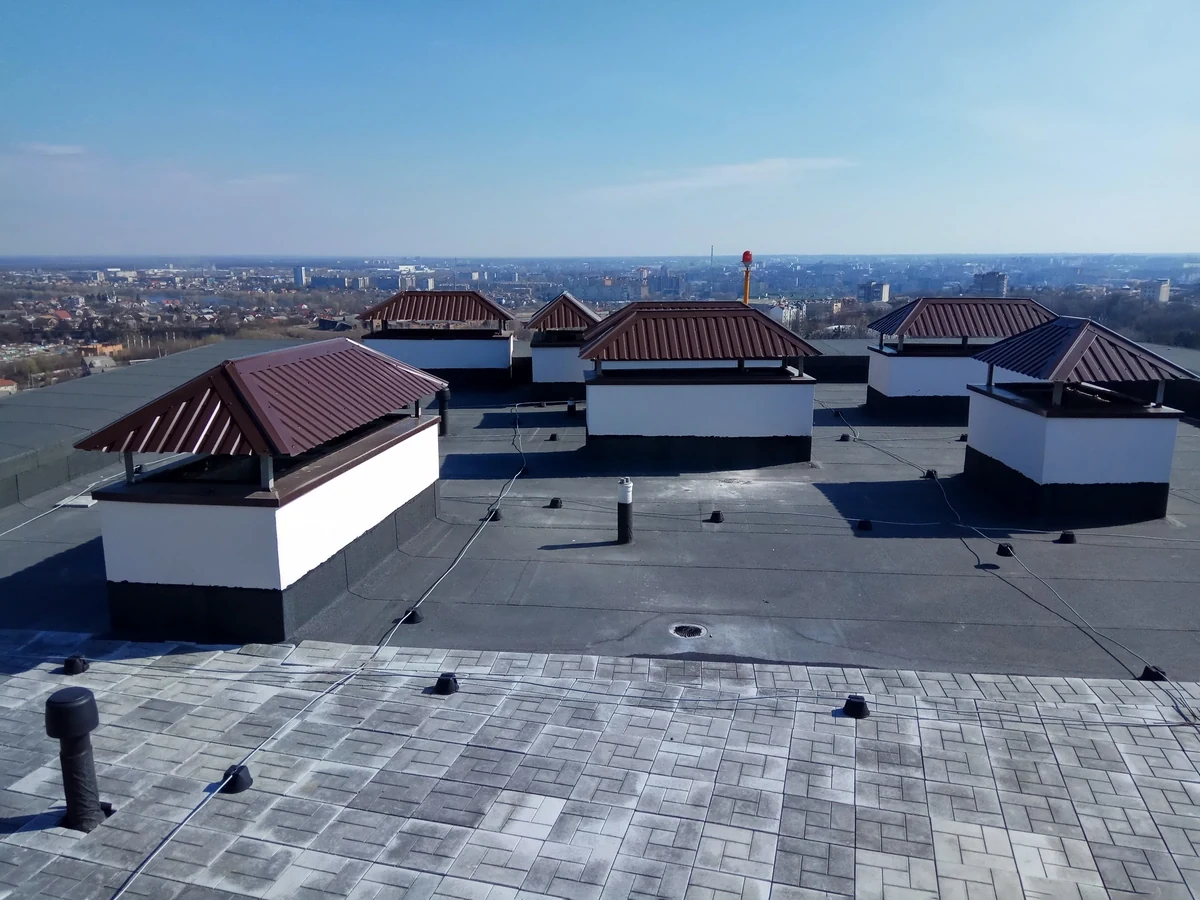
Energy company tenants downtown lease and release floor space as commodity cycles shift, and each round of tenant improvement work tends to add supplemental HVAC units, server room condensers, or communications equipment to the roof without always accounting for how that equipment interacts with the existing roof assembly. We frequently find curbs added over the years with inconsistent flashing quality, some clearly done by the original roofer and others clearly done by whoever the HVAC contractor had on hand that week.
- Core sampling to confirm insulation moisture condition before choosing recover versus tear-off
- Parapet coping cleat inspection on every downtown high-rise project
- Drain capacity recalculated against current roof area, not original design assumptions
- Rooftop equipment curb audit to catch inconsistent flashing from past tenant work
- Access and staging plan coordinated around an occupied, operating building
Working Over an Occupied Downtown Building
Reroofing a downtown office tower means working above tenants who are conducting business below, which changes how we stage material, manage noise during tear-off, and protect building entrances from debris. Elevator access, loading dock scheduling, and coordination with building management on which floors are occupied during which phase of the project all factor into how we sequence the job, and none of that logistics work shows up in a standard roofing bid unless it is planned for from the start.
Noise from tear-off work on a built-up roof, particularly gravel removal, is loud enough that we schedule the noisiest phases around tenant meeting schedules where building management can tell us. It is a small coordination step that avoids a much bigger disruption complaint later in the project.
Insulation Upgrades During a Downtown Recover Project
A recover project on an older built-up roof is also the practical opportunity to add insulation value that the building never had at original construction, since energy codes and insulation standards from the era these towers were built are well below what current tapered insulation systems can deliver. We evaluate whether the parapet height and existing roof edge details can accommodate additional insulation thickness before specifying an upgrade, since a taller insulation package changes the roof edge detail and coping height in ways that need to be planned rather than discovered mid-project.
What Downtown Building Owners Ask Before a Reroof
How do you know if a built-up roof needs full tear-off versus a recover?
Core sampling the existing insulation for moisture content tells us whether a recover is viable. Wet insulation under a new membrane fails quickly regardless of the membrane quality, so that sample result drives the decision.
Can a reroof happen without disrupting tenants below?
We plan staging, elevator access, and noisy work phases around building management's tenant schedule, which minimizes disruption but requires coordination that a standard bid does not automatically include.
Why does old rooftop equipment sometimes need to be re-flashed during a reroof?
Equipment added over years of tenant improvement work often has inconsistent flashing quality depending on who installed it, and a reroof project is the point where those curbs get brought up to a consistent standard.
Does a recover project let us add insulation the building never had?
In many cases yes, provided the parapet height and roof edge details can accommodate the added thickness, which we evaluate before finalizing the insulation spec.
How often should an older downtown office roof be inspected?
We recommend at minimum an annual inspection plus a walk-through after any significant hail or wind event, since older built-up systems show damage less obviously than newer single-ply membranes.