
Commercial Roofing Services
PVC Roofing in Midland, TX
PVC Membrane Roofing for Tank Batteries, Service Yards, and Industrial Buildings
PVC is the single-ply membrane we specify most often near active oilfield operations — tank battery support buildings, pipe yards, and vehicle maintenance facilities off I-20 and SH 158 where grease, oil overspray, and hydrocarbon exposure are part of daily operations. Its chemical resistance sets it apart from TPO and EPDM in exactly the situations this market produces more of than most.
Why Chemical Resistance Matters More Here
Most commercial roofing markets don't have to think hard about petroleum exposure on the membrane surface. The Permian Basin does. Buildings adjacent to compressor stations, saltwater disposal facilities, and equipment yards see grease, diesel overspray, and general hydrocarbon contact land on the roof surface over time, whether from nearby operations, rooftop equipment, or vehicle traffic below. PVC's polymer chemistry resists that kind of chemical attack significantly better than TPO's formulation, which can soften, discolor, or degrade with sustained oil and grease contact.
This isn't a theoretical concern we bring up to upsell a pricier membrane — it's the specific reason we steer service-yard and tank-battery-adjacent buildings toward PVC rather than defaulting to whatever membrane is cheapest per square. A membrane that degrades early because of a chemistry mismatch costs more over the building's life than the upfront price difference ever would.
We've seen TPO membranes on service-yard buildings show visible softening and discoloration within a few years where sustained grease contact was heavier than anticipated at the design stage, which is the kind of field evidence that shapes how we spec new roofs on similar buildings going forward rather than relying purely on manufacturer literature.
Seam Welding and Field Performance
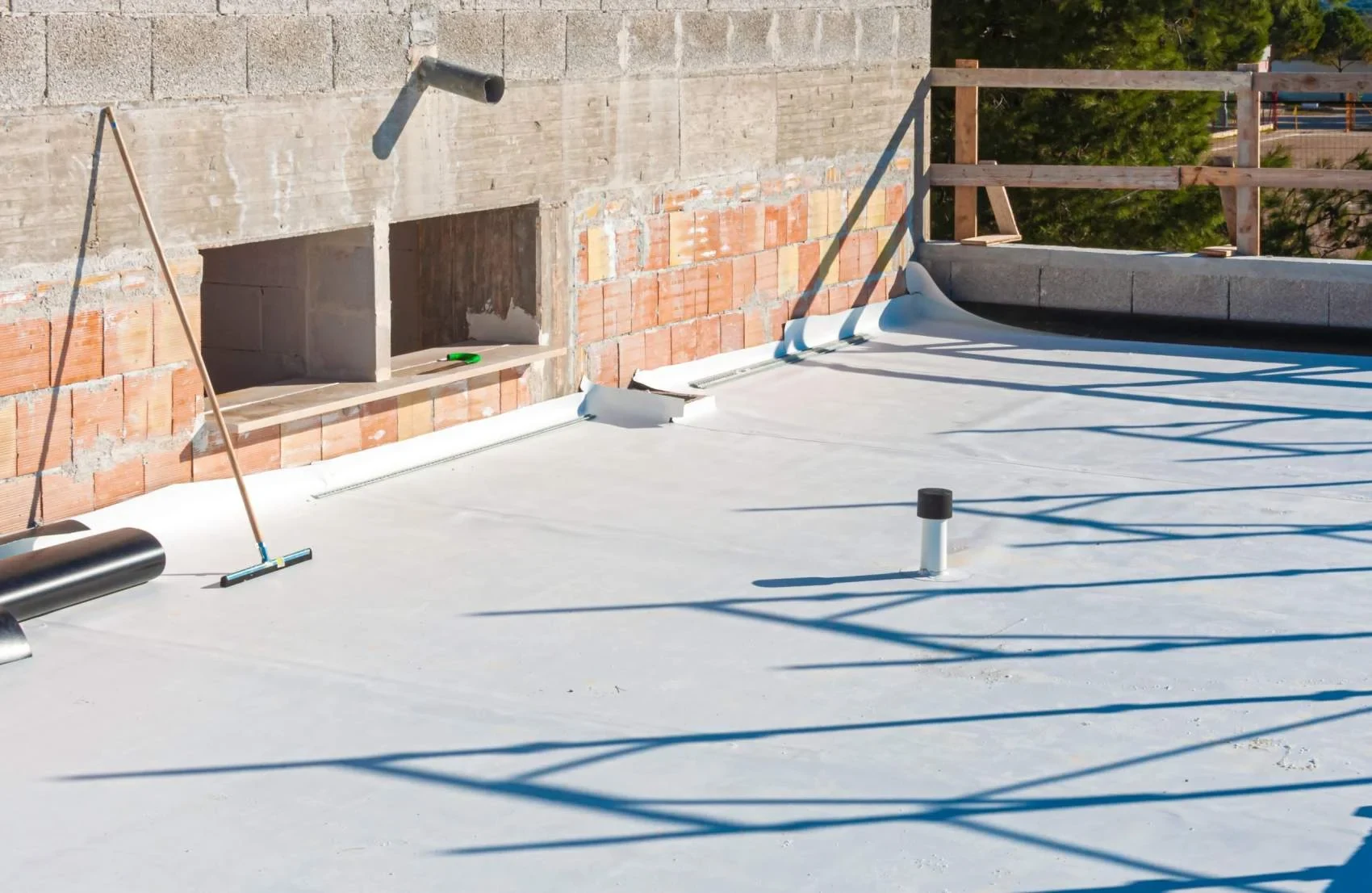
Like TPO, PVC seams are heat-welded rather than adhesive-bonded, fusing the sheets into a continuous, homogenous seam that carries wind uplift load across the field. PVC's internal plasticizer content affects long-term flexibility, and formulation quality varies more between manufacturers than it does with TPO, so we're selective about which PVC products we'll put on a roof rather than treating all PVC membranes as interchangeable.
On industrial buildings with heavier foot traffic from maintenance crews accessing rooftop equipment, PVC's puncture and tear resistance holds up well, which matters on service yard buildings where the roof isn't only weather protection — it's a working surface technicians are on regularly.
Thickness and Attachment for Industrial Buildings
We spec PVC thickness and attachment method against the building's actual use, not only its size:
- Membrane thickness sized to expected foot traffic and mechanical equipment loading
- Mechanically attached fastening pattern tightened at corners and perimeters for open-exposure sites
- Reinforced walkway pads at access points to high-traffic mechanical zones
- Flashing detail upgrades around penetrations common on industrial roofs — vents, stacks, conduit runs
- Drainage slope verification, since many pre-engineered metal building conversions have marginal slope to begin with
Pre-engineered metal buildings converted to low-slope PVC roofs — common when an oilfield operator repurposes a structure — often inherited whatever drainage slope the original building had, which isn't always adequate. We check that before finalizing a spec rather than assuming the existing roof geometry works.
Wind, UV, and the Rest of the Load Case
PVC still has to perform against the same wind uplift and UV exposure every membrane in this market faces. Its reflective white surface handles solar load similarly to TPO, keeping surface temperatures lower through Midland's high-UV, high-elevation summers than an unprotected black membrane would. Fastening patterns follow the same wind exposure category logic — tighter spacing at corners and perimeters on open industrial sites where there's little surrounding structure to break wind load.
We also account for thermal cycling in flashing and penetration details. Industrial buildings tend to have more roof penetrations per square foot than an office tower — exhaust stacks, conduit, tank vents — and each one is a potential failure point if the detailing doesn't account for the daily expansion and contraction this climate puts membranes through.
Cover board and walkway pad placement matter more on PVC industrial roofs than on a typical office building, since maintenance crews are on these roofs constantly servicing tank vents, compressors, and exhaust equipment. We map out expected traffic routes before installation and reinforce those paths specifically, rather than leaving the whole membrane to absorb foot traffic wear evenly.
Questions We Get About PVC on Industrial Sites
Why not simply use TPO everywhere and save on cost?
TPO is a fine membrane in the right application, but its resistance to sustained grease and hydrocarbon exposure is weaker than PVC's. On a building next to a maintenance bay or tank battery, that difference shows up as early membrane degradation, which costs more than the initial price gap.
Does PVC handle Permian Basin hail as well as other membranes?
Thickness and formulation quality matter more than membrane type alone. We spec thicker PVC with good puncture resistance on more exposed sites, similar to how we'd approach TPO thickness selection.
Can PVC go over an existing metal building's roof?
Often, if the deck and drainage are adequate. We check slope and moisture condition before recommending a recover instead of a tear-off on any pre-engineered building conversion.
Is PVC compatible with asphalt-based products already on a roof?
Not directly — PVC's plasticizers can react poorly with asphalt residue, so we detail a separation layer when tying into or recovering over an asphalt-based system.
How does PVC compare to a metal R-panel roof for a service yard building?
It depends on the building's slope and use. See our metal R-panel page for when exposed-fastener metal makes more sense than a low-slope membrane on the same kind of structure.